





Shinagawa Etchujima Campus Graduate School of Marine Science and Technology
The Graduate School of Marine Science and Technology has a doctoral course divided into a master's course and a doctoral course, and trains independent highly specialized professionals who open up cutting-edge fields.Furthermore, in collaboration with the Japan Fisheries Research and Education Agency, the Japan Agency for Marine-Earth Science and Technology, and the National Institute of Maritime, Port and Aviation Technology, we will further enhance education and research and improve the quality of graduate students. We are trying to
-

-
School of Marine Life ScienceShinagawa Campus
- Undergraduate Course of Marine Biosciences
- Undergraduate Course of Food Science and Technology
- Undergraduate Course of Marine Policy and Culture
-

-
School of Marine TechnologyEtchujima Campus
- Undergraduate Course of Maritime Systems Engineering
- Undergraduate Course of Marine Electronics and Mechanical Engineering
- Undergraduate Course of Logistics and Information Engineering
-

-
School of Marine Resources and EnvironmentShinagawa Campus
- Undergraduate Course of Ocean Sciences
- Undergraduate Course of Marine Resources and Energy
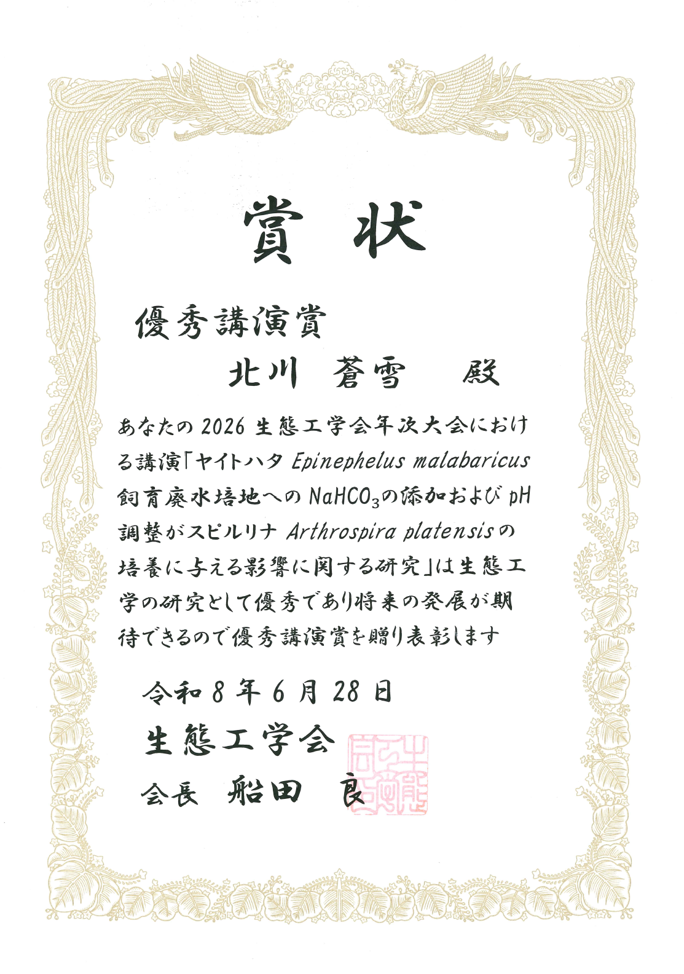
[Awards and Recognition] Aoi Kitagawa (2nd year Master's student) received the Outstanding Presentation Award at the 2026 Annual Meeting of the Japan Society for Ecological Engineering.
20266Month27from the day28The event held at Light Cube Utsunomiya took place over the course of several days.2026At the annual meeting of the Ecological Engineering Society, graduate student Aoyuki Kitagawa of our university received the Outstanding Presentation Award.
【Winner】
Aoi Kitagawa (Graduate School of Marine Science and Technology, Master's Program in Marine Bioresource Science) 2Year)
[Title of award-winning research]
Yellowtail grouperEpinephelus malabaricusTo the culture medium of wastewater from rearing plantsNaHCO₃Addition andpHAdjustment is spirulinaArthrospira platensisResearch on the effects on culture
(co-author: Kitagawa Aoyuki, (I.e.((I.e.)Monko, Masato Endo(Tokyo University of Marine Science and Technology), Ryodo Shimabukuro, Shingo Udagawa, Akihiro Takemura(University of the Ryukyus))
[Details of award-winning research]
In marine fish farming, there is a need to reduce the amount of substances discharged into the environment and the amount of fishmeal contained in the feed. Research is being conducted on a bio-recycling aquaculture method that involves cultivating the microalga spirulina in wastewater from marine fish farming and using it as a protein feed ingredient to replace fishmeal.
In this study, we used the amberjack grouper, a fish species targeted for marine aquaculture.Epinephelus malabaricusUsing the wastewater from the breeding programArthrospira platensisWith the aim of establishing efficient cultivation techniques, the effects of adding sodium bicarbonate to wastewater from the rearing of the grouper were investigated.pHWe examined the effects of the adjustments.
As a result, in the culture medium in which deficient elements were added to the wastewater from the rearing of the grouper3g/LThe addition of sodium bicarbonate as described above ensures stable growth.pH8Controlling it front and back means no adjustment is needed.pH9,pH10Compared to the controlled experimental plots, the growth rate was lower, but it was found that spirulina containing high concentrations of nitrogen and phosphorus could be produced. Furthermore, elemental composition analysis and analysis using dissolution-precipitation equilibrium software suggested that the growth inhibitors were calcium and magnesium, which are present in large quantities in the culture water. This indicates that controlling the elemental concentrations and dissolution of the culture medium is important for efficiently cultivating spirulina using aquaculture wastewater.
This research provides valuable insights that will significantly contribute to the development of material recycling technology, which utilizes water pollutants excreted by marine fish to promote the growth of microalgae that serve as feed ingredients, thereby removing them from wastewater. The findings were highly praised by the judges.
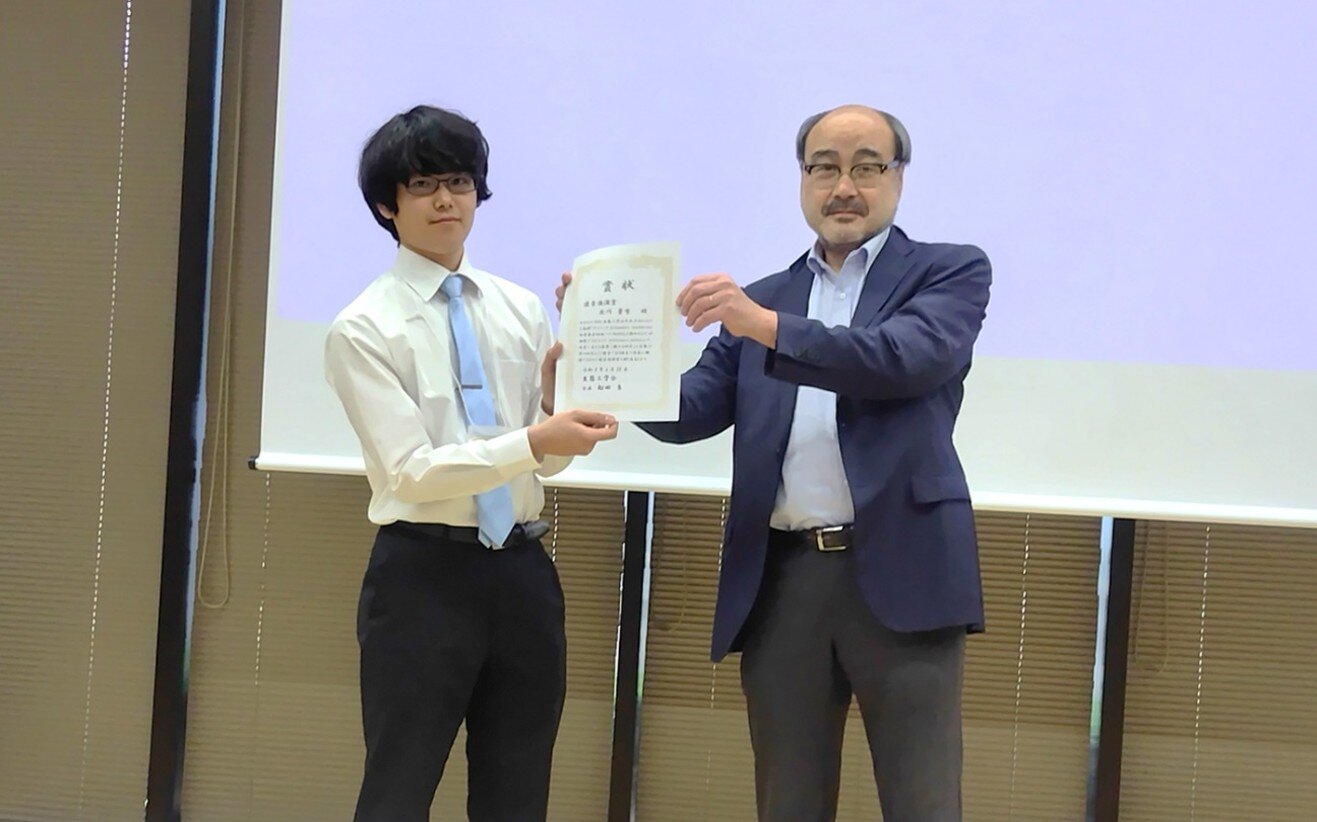
Kitagawa (pictured left)
<Related links>
Ecological Engineering Society
-
School of Marine Life ScienceShinagawa Campus
- Undergraduate Course of Marine Biosciences
- Undergraduate Course of Food Science and Technology
- Undergraduate Course of Marine Policy and Culture
-
School of Marine TechnologyEtchujima Campus
- Undergraduate Course of Maritime Systems Engineering
- Undergraduate Course of Marine Electronics and Mechanical Engineering
- Undergraduate Course of Logistics and Information Engineering
-
School of Marine Resources and EnvironmentShinagawa Campus
- Undergraduate Course of Ocean Sciences
- Undergraduate Course of Marine Resources and Energy

-
Graduate School of Marine Science and TechnologyShinagawa Etchujima Campus
- Master's course
- Doctoral course
