






Shinagawa Etchujima Campus Graduate School of Marine Science and Technology
The Graduate School of Marine Science and Technology has a doctoral course divided into a master's course and a doctoral course, and trains independent highly specialized professionals who open up cutting-edge fields.Furthermore, in collaboration with the Japan Fisheries Research and Education Agency, the Japan Agency for Marine-Earth Science and Technology, and the National Institute of Maritime, Port and Aviation Technology, we will further enhance education and research and improve the quality of graduate students. We are trying to
-

-
School of Marine Life ScienceShinagawa Campus
- Undergraduate Course of Marine Biosciences
- Undergraduate Course of Food Science and Technology
- Undergraduate Course of Marine Policy and Culture
-

-
School of Marine TechnologyEtchujima Campus
- Undergraduate Course of Maritime Systems Engineering
- Undergraduate Course of Marine Electronics and Mechanical Engineering
- Undergraduate Course of Logistics and Information Engineering
-

-
School of Marine Resources and EnvironmentShinagawa Campus
- Undergraduate Course of Ocean Sciences
- Undergraduate Course of Marine Resources and Energy
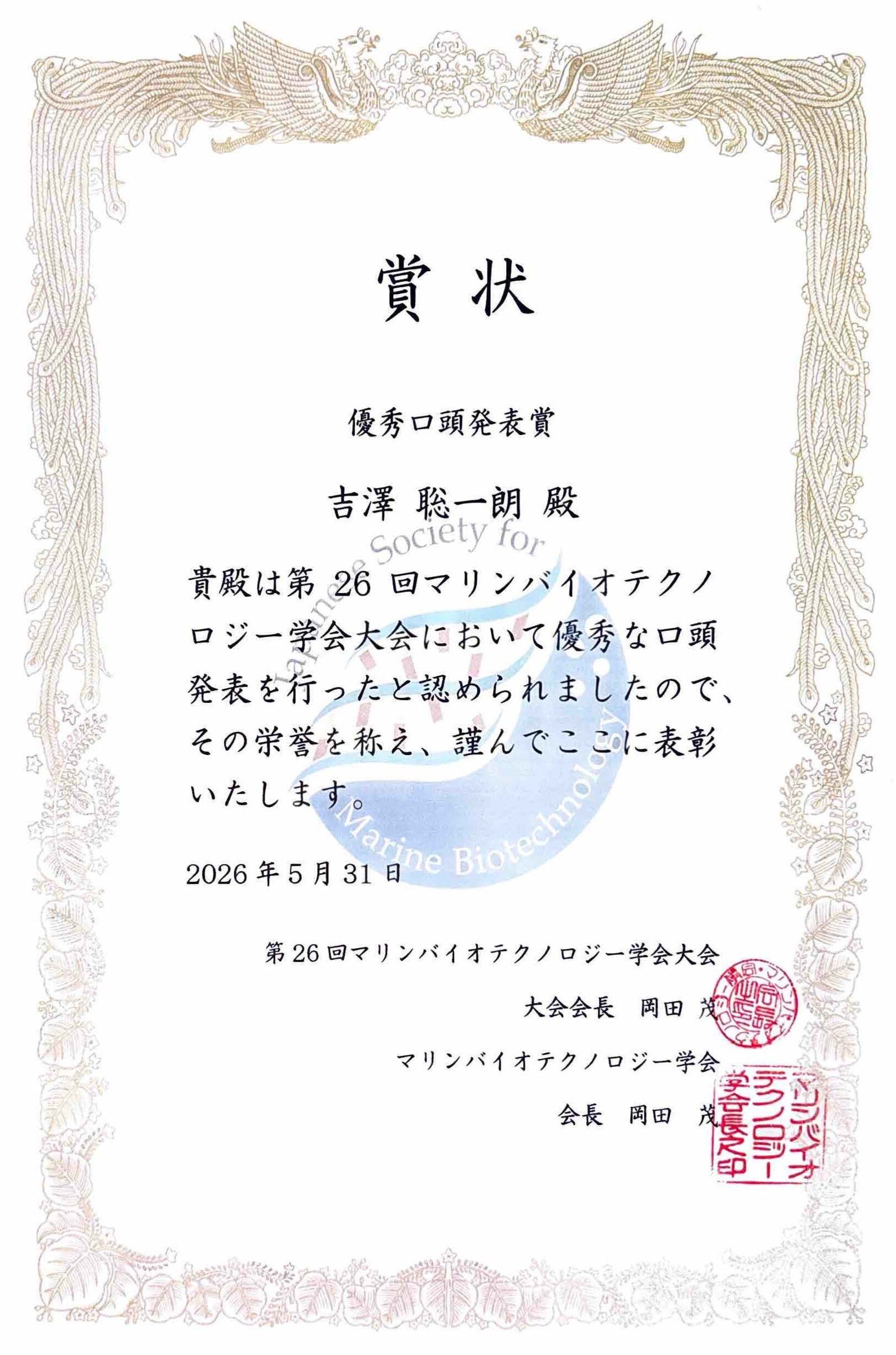
[Awards and Recognition] Soichiro Yoshizawa (2nd year doctoral student) received the Student Outstanding Oral Presentation Award at the 26th Annual Meeting of the Marine Biotechnology Society.
November 30st, 2026 ~ November 11thAt the 26th Annual Meeting of the Marine Biotechnology Society, held at our university's Shinagawa Campus, graduate student Soichiro Yoshizawa received the Student Outstanding Oral Presentation Award.
【Winner】
Soichiro Yoshizawa (2nd year doctoral student, Department of Applied Life Sciences, Graduate School of Marine Science and Technology)
[Title of award-winning research]
Development of a control agent for Edwardsiella disease using antibodies derived from cartilaginous fish
[Details of award-winning research]
In this study, we developed an artificial antibody (VNAR) against Edwardsiella disease, a bacterial infection that is a problem in flounder farming, by applying a special antibody found in cartilaginous fish such as sharks and rays. By genetically engineering a VNAR that binds to a protein present on the surface of pathogenic bacteria, we found that this VNAR suppressed bacterial growth and was effective in protecting flounder from infection. These research results are expected to lead to new fish disease control measures that do not rely on antibiotics.
<Related links>
The 26th Annual Meeting of the Marine Biotechnology Society
-
School of Marine Life ScienceShinagawa Campus
- Undergraduate Course of Marine Biosciences
- Undergraduate Course of Food Science and Technology
- Undergraduate Course of Marine Policy and Culture
-
School of Marine TechnologyEtchujima Campus
- Undergraduate Course of Maritime Systems Engineering
- Undergraduate Course of Marine Electronics and Mechanical Engineering
- Undergraduate Course of Logistics and Information Engineering
-
School of Marine Resources and EnvironmentShinagawa Campus
- Undergraduate Course of Ocean Sciences
- Undergraduate Course of Marine Resources and Energy

-
Graduate School of Marine Science and TechnologyShinagawa Etchujima Campus
- Master's course
- Doctoral course
